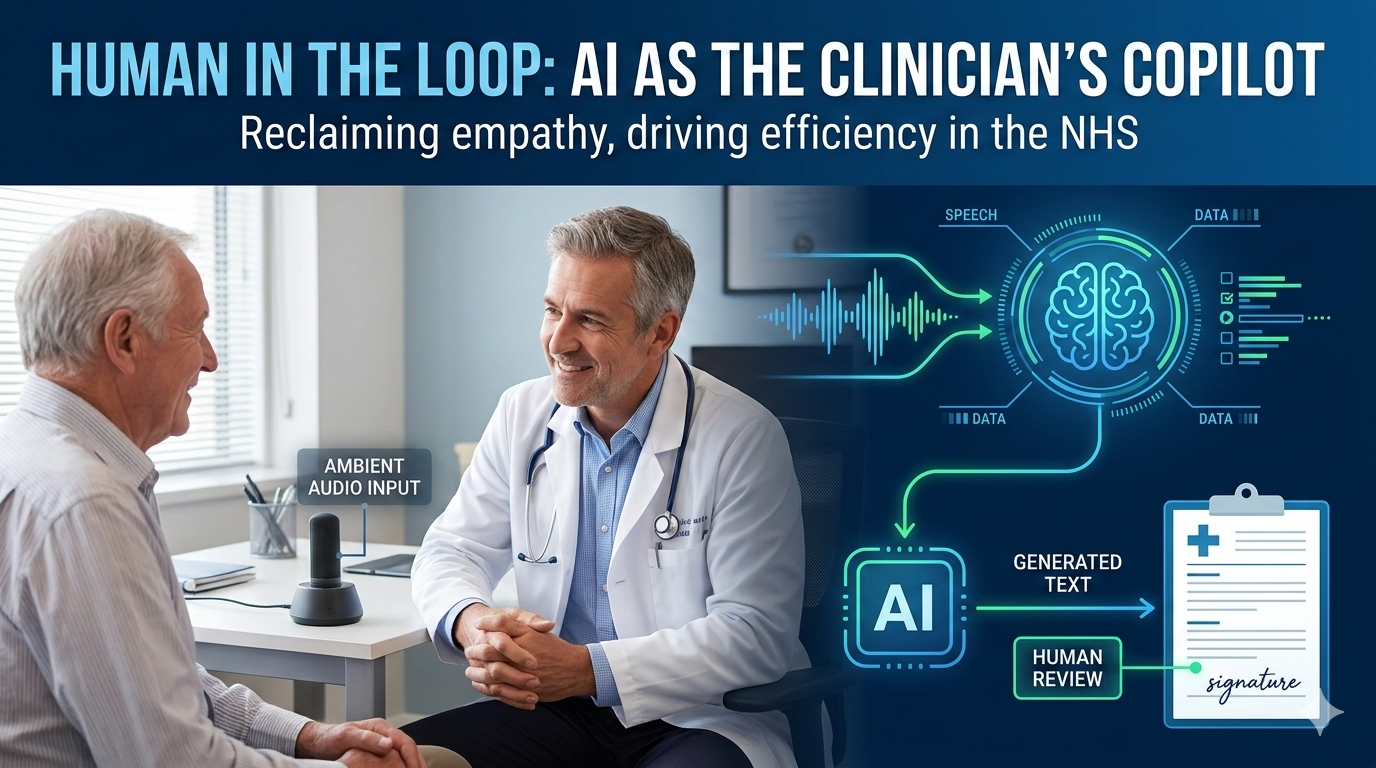
The idea of “Human in the Loop” (HITL) isn’t just a tech buzzword; it’s basically the secret sauce for making AI actually work in the real world. We often hear these “AI vs. Humans” doom-and-gloom stories, but the reality is much more collaborative. The best way forward isn’t about replacing people; it’s about using AI to handle the “robotic” parts of a job so humans can get back to being, well, human.
A perfect example of this is happening right now in the UK with the Manchester University NHS Foundation Trust, where clinicians are using a tool called Microsoft Dragon Copilot.
Reclaiming the Human Connection
In healthcare, the biggest complaint from both doctors and patients is often the “third wheel” in the room: the computer screen. Doctors spend a massive amount of their time typing notes and clicking through menus instead of looking their patients in the eye.
By using ambient voice technology, the Dragon Copilot system acts as a silent assistant. It listens to the conversation between a doctor—like cardiologist Dr. Charles Pearman—and the patient, transcribes it, and organizes the medical notes automatically. Because the AI handles the “paperwork” in real-time, the doctor can actually sit face-to-face with the patient. That’s the “Human in the Loop” philosophy in action: the AI manages the data, but the human manages the relationship and the high-stakes decision-making.+2
Efficiency Without the Burnout
The math behind this collaboration is pretty impressive. Dr. Pearman noted that saving just three to five minutes per patient might not sound like a lot, but over a full morning of consultations, that time adds up. It’s enough to potentially see an extra patient or, just as importantly, reduce the soul-crushing administrative burden that leads to physician burnout.
Mark Cubbon, the Chief Executive of the Trust, pointed out that by rolling this technology out, they could potentially treat up to a quarter of a million more patients every year. That’s a massive scale-up in care, achieved not by making doctors work harder, but by making the system work smarter around them.
Safety and the Final Say
The reason “Human in the Loop” is the best way forward—and not just a “good” way—comes down to accountability. The AI drafts the notes, summarizes the referrals, and pulls up records, but the clinician is always the one who proofs, signs, and ultimately decides on the treatment.
As the Microsoft feature highlights, human interaction is at the heart of healthcare. AI can spot patterns in data or transcribe a conversation with “uncanny” accuracy, but it doesn’t have empathy, and it doesn’t understand the nuance of a patient’s life story. By keeping the human in the loop, we get the best of both worlds: the lightning-fast processing power of AI and the ethical, emotional, and expert judgment of a person.
The Bottom Line
The Manchester pilot program shows that when we stop viewing AI as a replacement and start viewing it as a “Copilot,” everyone wins. Clinicians get their time back, patients get more focused attention, and the healthcare system becomes more efficient. Moving forward, the goal for any industry shouldn’t be “full automation,” but rather “empowered participation”—using technology to strip away the busywork so humans can focus on the work that actually matters.
Reference: https://news.microsoft.com/source/emea/features/ai-tool-for-clinicians/