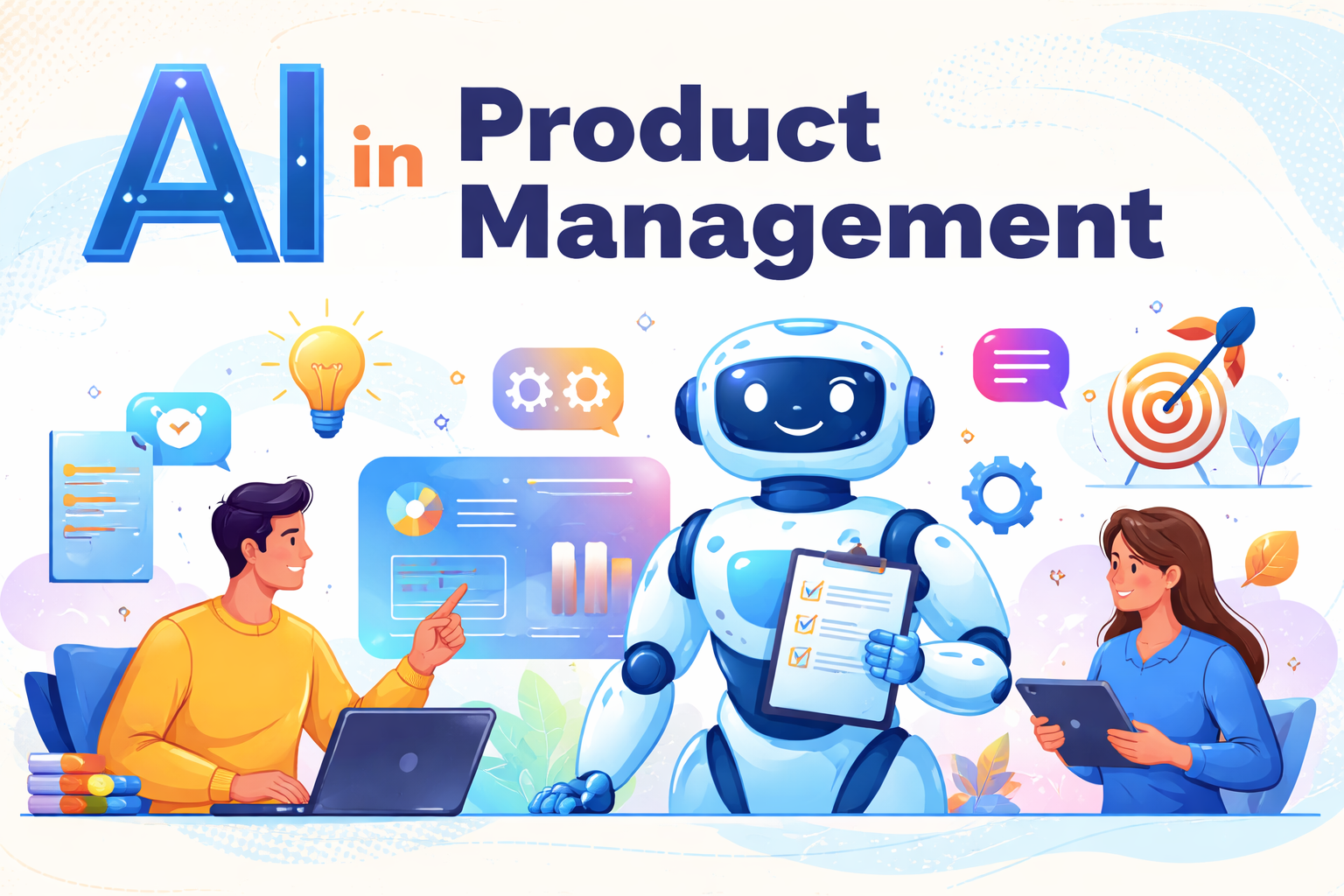
Using AI in Product Management has quickly evolved from an experimental concept into a strategic necessity. In today’s competitive digital environment, product managers are expected to interpret massive data streams, anticipate customer behaviour, and deliver high-performing products faster than ever before. Traditional approaches based purely on intuition or static reports no longer provide sufficient accuracy or speed. Artificial intelligence fills this gap by transforming raw data into actionable insights, enabling product teams to make smarter, faster, and more confident decisions.
Organisations such as Google, Amazon, and Microsoft have already embedded AI deeply into their product ecosystems. Their success demonstrates that AI is not merely a technical upgrade but a fundamental shift in how products are envisioned, built, and optimised. Understanding how AI supports product management requires examining its strategic, operational, and ethical dimensions in depth.
The Strategic Importance of Using AI in Product Management
Product management revolves around making decisions under uncertainty. Teams must determine which problems are worth solving, which features deserve prioritisation, and how to allocate limited resources. Traditionally, these decisions relied on historical data, stakeholder opinions, and market research reports. While useful, these methods often lacked predictive power and real-time responsiveness.
Using AI in Product Management introduces predictive analytics that allows leaders to anticipate market trends before they fully emerge. Machine learning algorithms process historical usage patterns and behavioural data to forecast demand, churn risk, and feature adoption rates. Rather than reacting to performance declines, teams can proactively adjust strategy.
Furthermore, AI enhances strategic clarity by eliminating bias in decision-making. Human judgment, while valuable, can be influenced by cognitive shortcuts and personal preferences. AI systems evaluate data objectively, highlighting opportunities based on measurable impact rather than internal politics. This data-driven prioritisation creates alignment across cross-functional teams and strengthens executive confidence in product roadmaps.
Understanding Artificial Intelligence in the Product Context
Artificial intelligence encompasses multiple technologies, including machine learning, natural language processing, and predictive modelling. Machine learning enables systems to learn from past data and improve future predictions without manual reprogramming. For example, recommendation engines used by Netflix analyse viewing patterns to personalise content suggestions, significantly increasing user engagement.
Natural language processing allows AI systems to interpret human language. In product management, this capability transforms customer feedback, support tickets, and social media comments into structured insights. Instead of manually reading thousands of reviews, product teams can rely on AI-driven sentiment analysis to identify recurring frustrations or feature requests.
Predictive analytics integrates these capabilities to estimate future outcomes. By modelling user behaviour trends, AI can forecast which customer segments are most likely to convert, which users are at risk of churn, and which new features may drive adoption. This predictive capacity fundamentally changes how product managers allocate resources and manage risk.
Enhancing Customer Understanding Through AI
Customer-centricity is at the heart of effective product management. However, as digital platforms scale globally, understanding diverse user bases becomes increasingly complex. Using AI in Product Management allows teams to analyse millions of user interactions across websites, mobile apps, and support systems.
Behavioural analytics powered by AI identifies friction points within user journeys. For instance, if customers frequently abandon a checkout page at a specific step, AI systems detect the pattern and alert product teams. This level of insight enables rapid iteration and experience optimisation.
AI-driven sentiment analysis further deepens understanding by categorising feedback into positive, neutral, or negative emotional tones. This emotional mapping provides clarity on how customers truly feel about product features. Rather than relying solely on survey scores, teams gain nuanced insights into satisfaction drivers and pain points.
Additionally, AI tools consolidate fragmented data sources into unified dashboards. Instead of switching between analytics platforms, CRM systems, and survey tools, product managers access comprehensive real-time insights in a single interface. This integration improves efficiency and strategic focus.
AI-Powered Roadmap Planning and Prioritisation
One of the most challenging aspects of product management is deciding what to build next. Competing stakeholder demands, limited development capacity, and market pressures often create tension. AI introduces a systematic method for evaluating opportunities based on projected impact.
Through opportunity scoring models, AI assesses potential features according to predicted revenue growth, user demand, development effort, and associated risk. These models incorporate historical data and predictive trends to estimate return on investment. As a result, roadmap decisions become evidence-based rather than opinion-driven.
Risk forecasting capabilities also enhance planning accuracy. AI systems identify patterns that signal potential project delays or adoption challenges. For example, if similar features historically faced low engagement, the system flags the risk before significant resources are invested. This proactive risk management reduces costly failures.
Transforming the Product Development Lifecycle
AI does not stop at strategic planning; it influences the entire product development lifecycle. During ideation, generative AI tools assist in brainstorming by analysing industry trends and suggesting innovative concepts. While human creativity remains essential, AI accelerates the exploration process.
In prototyping stages, AI-driven design tools recommend layout adjustments based on usability best practices and previous user behaviour patterns. These recommendations increase the likelihood of positive user experiences from the outset.
Testing and optimisation also benefit from automation. AI-powered A/B testing platforms dynamically adjust experiments in real time, automatically allocating traffic to higher-performing variations. This continuous optimisation improves product performance without manual intervention.
Post-launch monitoring becomes more sophisticated through anomaly detection systems. If user engagement suddenly drops or error rates increase, AI immediately identifies the deviation and alerts teams. Early detection allows rapid response, preserving customer trust and revenue.
Ethical Considerations and Responsible AI Use
While using AI in Product Management offers significant advantages, ethical responsibility must remain a priority. AI systems rely on large datasets, which may include sensitive user information. Compliance with global data protection regulations is essential to maintain trust.
Organisations must also address algorithmic bias. If training data contains historical inequities, AI predictions may inadvertently reinforce them. Transparent governance frameworks and regular audits help mitigate this risk. Institutions such as the World Economic Forum emphasise the importance of ethical AI adoption in business environments.
Human oversight remains indispensable. AI should augment, not replace, human judgment. Product managers must interpret AI-generated insights critically and consider contextual factors beyond data patterns.
Challenges in Implementation
Despite its benefits, implementing AI in product management presents obstacles. Data quality often determines AI effectiveness. Incomplete or inconsistent datasets can lead to inaccurate predictions. Therefore, organisations must invest in data infrastructure and governance before deploying advanced analytics tools.
Skill gaps also pose challenges. Product managers need a foundational understanding of data science concepts to interpret AI outputs effectively. Cross-functional collaboration between product, engineering, and data teams becomes increasingly important.
Cultural resistance may arise as well. Some stakeholders fear automation may reduce human influence. Clear communication about AI’s supportive role helps ease these concerns and encourages adoption.
The Future of AI in Product Leadership
The trajectory of AI development suggests even deeper integration into product management practices. As generative AI capabilities advance, product teams may use AI to simulate entire market scenarios, prototype concepts instantly, and personalise experiences at scale.
Forward-thinking organisations recognise that competitive advantage will increasingly depend on intelligent systems. However, success requires strategic alignment, ethical vigilance, and continuous learning. AI tools evolve rapidly, and product managers must stay informed to maximise their value.
Frequently Asked Questions
Many professionals wonder whether AI will replace product managers. The reality is that AI enhances analytical capacity but cannot replicate human empathy, vision, and leadership. Others question whether small organisations can afford to adopt AI. In fact, many cloud-based AI solutions offer scalable pricing models accessible to startups. Concerns about data privacy are valid, but adherence to established regulatory frameworks and transparent communication practices mitigates risks effectively. Some ask whether AI predictions guarantee product success. While AI significantly improves forecasting accuracy, it does not eliminate uncertainty. Strategic judgment remains essential.
Conclusion
Using AI in Product Management represents a paradigm shift in how products are conceived, developed, and refined. By transforming raw data into predictive insights, AI empowers product leaders to move from reactive problem-solving to proactive strategy execution. It strengthens customer understanding, enhances roadmap prioritisation, optimises development cycles, and supports sustainable innovation.
Yet, the true power of AI lies not in automation alone but in intelligent collaboration between technology and human expertise. Organisations that combine analytical rigour with ethical responsibility will shape the future of product innovation. In this rapidly evolving landscape, embracing AI thoughtfully is no longer optional—it is the foundation of modern product excellence.