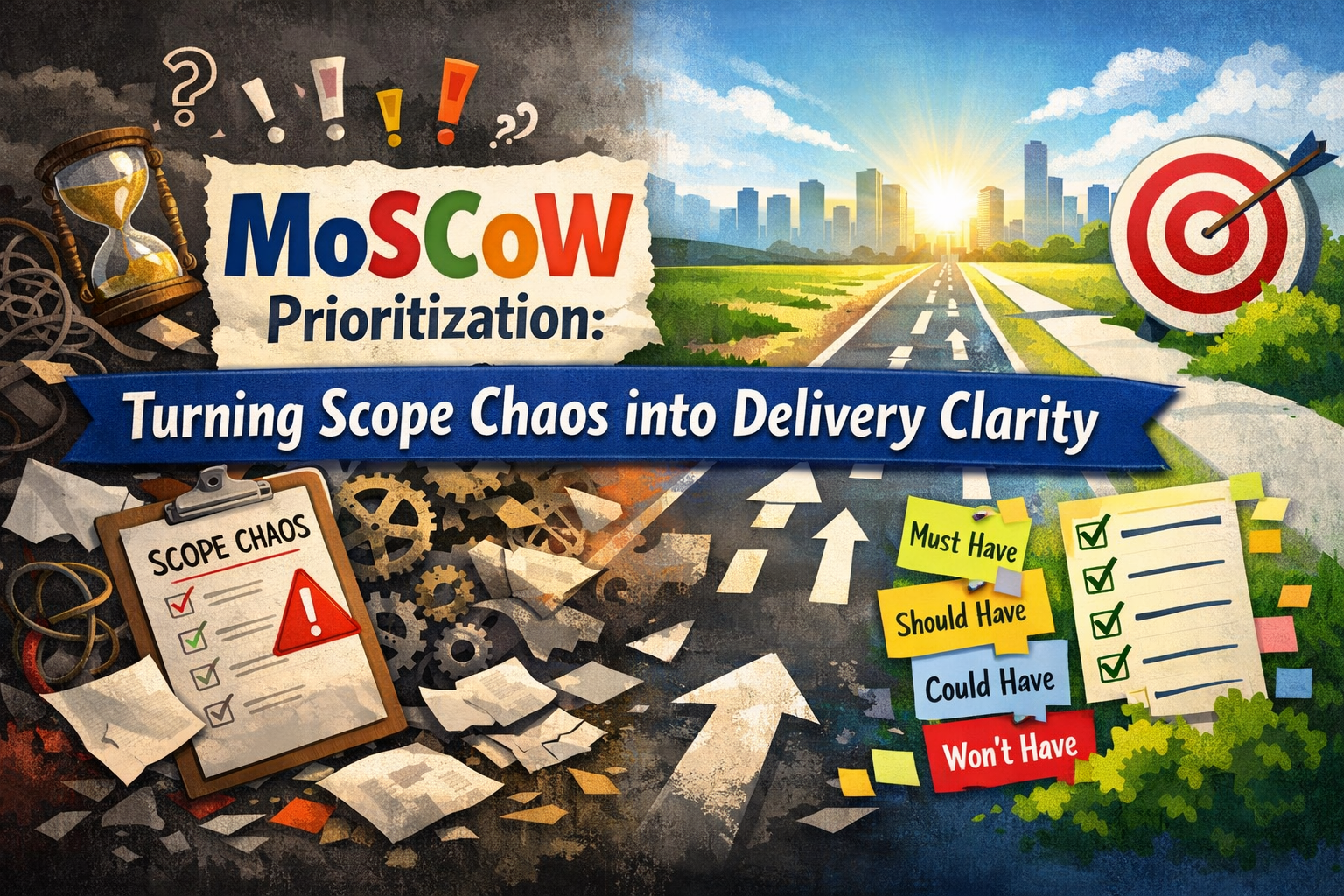
MoSCoW is a scope-prioritization framework that classifies work into Must have, Should have, Could have, and Won’t have (for now). It is especially effective when teams need to align execution under hard deadlines, such as launches, migrations, compliance windows, or contractual commitments.
The value of MoSCoW is its simplicity. When every requirement is labeled “critical,” no requirement is critical. By forcing explicit tiering, MoSCoW protects delivery integrity and reduces late-cycle panic.
Each category has a specific behavioral meaning:
- Must have: Without this, the release fails.
- Should have: Important and valuable, but launch can proceed without it.
- Could have: Useful enhancements if time permits.
- Won’t have: Explicitly out of scope for the current cycle.
Most teams misuse MoSCoW by overfilling the Must-have bucket. A good rule is that Must-have items should consume no more than 60% of expected team capacity. This creates real room for unknowns and avoids emergency scope cuts during QA.
Another key advantage is stakeholder communication. A structured MoSCoW list allows product leaders to explain tradeoffs in plain language: “This is a Should-have and will ship next cycle if Must-haves remain on track.” That reduces conflict and protects trust.
MoSCoW works best when combined with objective acceptance criteria and visible release gates. A Must-have without a testable completion definition is a risk label, not a requirement.
Example: Mobile Banking App Release
A bank plans a mobile app release before a regulatory deadline. Candidate items include:
- Biometric login
- Transfer limit controls
- Spending insights dashboard
- Dark mode
- Card freeze/unfreeze
- Referral program
After workshop prioritization:
- Must have: Transfer limit controls, card freeze/unfreeze, mandatory security logging
- Should have: Biometric login, spending insights dashboard
- Could have: Dark mode, referral program
- Won’t have: New rewards marketplace integration
Mid-sprint, integration testing reveals a security defect requiring two engineer-weeks. Because priorities were explicit, the team pauses two Could-have items and one Should-have item without debate and still meets release commitments.
MoSCoW did not increase engineering velocity. It increased decision velocity. In high-stakes delivery, that is often the bigger constraint.