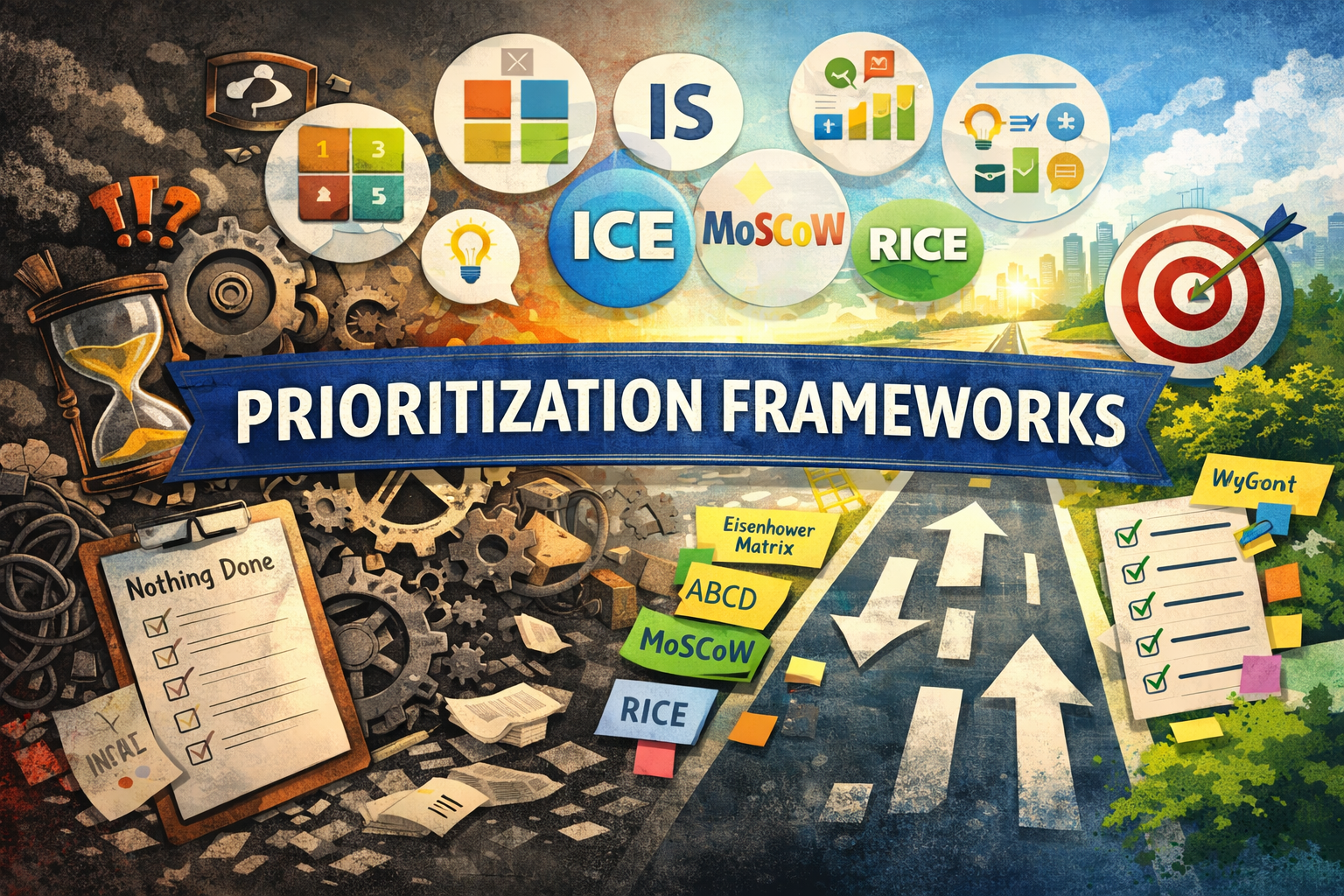
RICE is one of the most practical prioritization frameworks for product teams because it forces a decision across four dimensions that are normally argued separately: Reach, Impact, Confidence, and Effort. Most roadmap debates collapse into opinion because teams discuss user value, engineering complexity, and strategic urgency in different meetings. RICE works because it compresses those arguments into one comparable score.
At a high level, the formula is simple:
RICE Score = (Reach × Impact × Confidence) / Effort
Reach estimates how many users will be affected in a defined period, such as one quarter. Impact estimates the magnitude of benefit per user, often on a simple scale such as 3 for massive, 2 for high, 1 for medium, and 0.5 for low. Confidence forces explicit uncertainty handling. Effort is the total person-months required across design, engineering, QA, and launch operations.
The strongest part of RICE is not the math. It is the discipline of making assumptions visible. A team that says “this is high impact” without quantifying reach or confidence is usually mixing hope with data. RICE separates what is known from what is believed. That separation improves planning quality and stakeholder trust.
A practical way to run RICE in a weekly planning cycle is:
- Define the time window for reach estimation.
- Require a source for each reach estimate.
- Keep impact scales consistent across teams.
- Enforce confidence penalties for weak evidence.
- Include real cross-functional effort, not just coding.
Common failure modes are predictable. Teams inflate impact to win prioritization arguments. Confidence is often overestimated, especially for new user segments. Effort gets underestimated when integration or migration work is ignored. If those distortions are left unchecked, RICE becomes pseudo-quantitative theater.
A reliable governance pattern is to review the top ten scored items once per sprint and challenge one assumption per item. Even if the final order does not change much, the quality of decision-making improves because the model remains grounded in evidence.
Example: B2B SaaS Onboarding Improvements
A product team at a workflow SaaS company has three candidate initiatives:
- Interactive first-run checklist
- CRM import wizard
- New dashboard visual redesign
The team estimates quarterly values:
- Checklist: Reach 4,000 users, Impact 1.5, Confidence 80%, Effort 2
- CRM Wizard: Reach 1,200 users, Impact 2, Confidence 70%, Effort 3
- Dashboard redesign: Reach 6,000 users, Impact 0.5, Confidence 90%, Effort 4
RICE scores:
- Checklist: (4000 × 1.5 × 0.8) / 2 = 2400
- CRM Wizard: (1200 × 2 × 0.7) / 3 = 560
- Dashboard redesign: (6000 × 0.5 × 0.9) / 4 = 675
The checklist clearly leads. Without RICE, the visual redesign might have won due to visibility and executive preference. With RICE, the team prioritizes measurable activation impact with lower effort and stronger expected return.
The core lesson is that RICE gives a product team a repeatable decision mechanism under uncertainty. It does not remove judgment; it structures judgment.