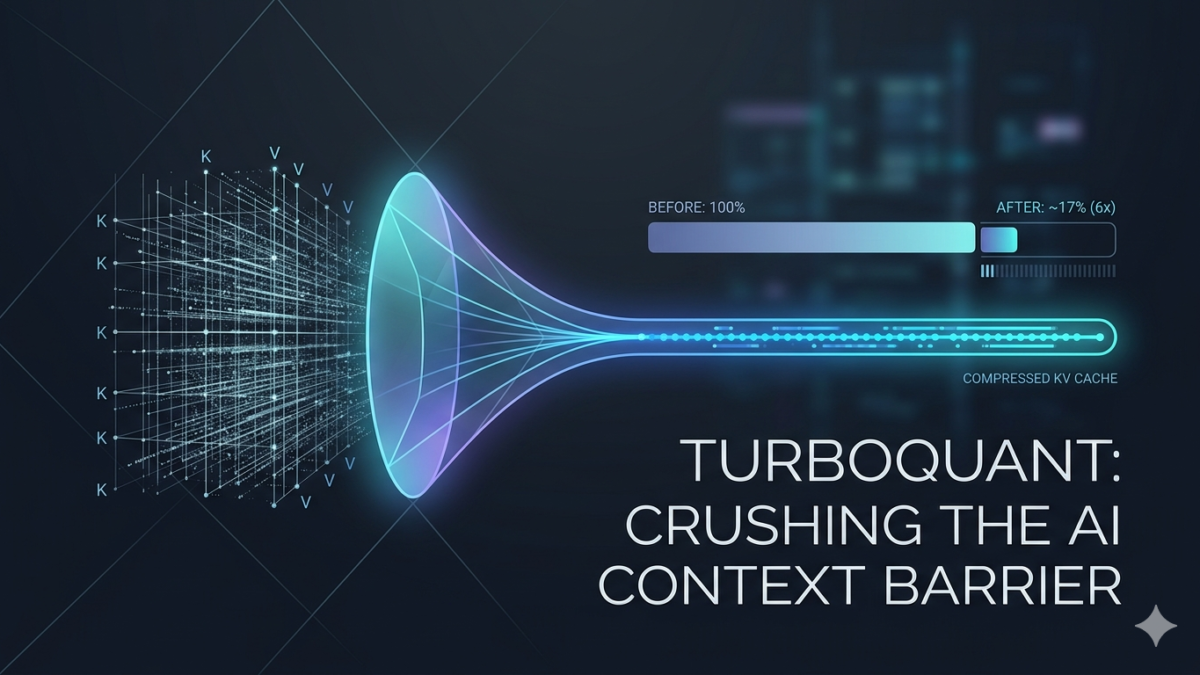
For years, the generative AI world has been fighting a quiet, expensive, and frustrating war. The enemy? Memory. Specifically, Key-Value (KV) cache memory.
We love it when AIs like ChatGPT can remember what we said ten minutes ago. We love pasting an entire book into an LLM and asking questions. This is called the “context window.” But there’s a brutal trade-off: The longer the context window, the more graphics memory (VRAM) the AI consumes.
When the memory fills up, the AI hits the wall. It either slows down dramatically or crashes with the dreaded “Out of Memory” (OOM) error. Until now, the only solution was to throw hundreds of millions of dollars at more expensive GPUs.
But this week, Google Research unleashed TurboQuant.
In what can only be described as an absolute landmark breakthrough, Google researchers have found a way to compress that crucial KV cache by 6x with, effectively, zero accuracy loss. It’s the closest thing to a “free lunch” in AI deployment history.
The Problem: The “Context-Memory Paradox”
To understand why TurboQuant is such a big deal, we need to understand why context is so memory-hungry.
LLMs generate answers by focusing on the relationship between every token (word or chunk of text). In a model like GPT-4, it must build and maintain a giant lookup table of “Keys” and “Values” (KV cache) for every single word in the conversation.
Think of it like this:
- Context window of 4K: Imagine storing a thousand high-resolution photos on your phone. Easy.
- Context window of 100K: Now, you are trying to store every scene of a feature-length movie as individual high-resolution photos on that same phone. The storage fills up instantly.
As the text gets longer, the KV cache grows exponentially. Traditional compression tools (like FP16 to INT8 quantization) have been tried, but they inevitably degrade the AI’s logic and “attention” capabilities, making the AI hallucinate wildly as the conversation progresses.
The TurboQuant Breakthrough: A Two-Step Magic Trick
Google didn’t just make a better compressor; they rethink the fundamental geometry of LLM data. The team realized that traditional “linear” quantization methods (like converting 16-bit to 4-bit) were inefficient because of outliers. One very large number makes the whole system waste data space just to capture it.
TurboQuant solves this with a sophisticated, mathematically elegant two-step pipeline.
Step 1: The PolarQuant “Shorthand”
This is the main innovation. Standard digital memory stores numbers on an X-Y (Cartesian) grid. Google’s team realized that LLM “attention heads” actually have a predictable structure when viewed in a different way: Polar Coordinates (Radius and Angle).
- Normalization: They take the giant block of data and break it down into tiny 16×16-token “unit spheres.”
- Polar Mapping: They convert the coordinates from X-Y to Polar.
- The Predictability Trick: Here’s the key insight: The distribution of angles in an LLM is remarkably well-behaved and predictable. Because it’s so predictable, they can map the data onto a fixed mathematical grid without having to store the extra setup data (outlier parameters) that traditional compression always required. They called this “grid-based outlier-free quantization.”
They can crush the angles down using mere 3-bit or 4-bit representation, achieving massive memory savings immediately.
Step 2: The QJL Residual “Eraser”
Even with PolarQuant, when you compress data that aggressively, you lose some accuracy. There will be tiny rounding errors. These tiny errors, when added up, can break the AI’s logic.
This is where the second step comes in. It’s called a Quantized Johnson-Lindenstrauss (QJL) transform.
- Calculating the Error: TurboQuant takes the compressed data and subtracts it from the original data to find the exact “residual error.”
- Compressing the Error: QJL compresses that residual error into a tiny, hyper-efficient 1-bit representation.
- Bias Correction: Instead of trying to reconstruct the exact data, the QJL layer acts as a mathematical “bias-corrector,” ensuring that the total error (bias) is effectively zero.
It doesn’t make the compression “perfect,” but it makes the AI’s final attention score calculation mathematically equivalent to the uncompressed version.
The Massive Impact
The results are staggering. In Google’s tests running on a cluster of NVIDIA H100 GPUs (the current gold standard for AI), the results were immediate:
- 6x Cache Compression: This means you can fit a context window that is six times larger into the same amount of VRAM. A 32GB consumer GPU that previously topped out at an 8,000-token context might now handle 48,000 tokens comfortably.
- Zero Accuracy Loss: Google benchmarked this on extremely demanding tasks like LongBench and “Needle In A Haystack” (finding one sentence in 128K tokens). There was no noticeable degradation in performance compared to uncompressed models.
- 8x Attention Kernel Speed: This isn’t just a memory saver; it’s a speed boost. Because the compressed data fits better on the GPU and is computed more efficiently, the actual “thinking” process (calculating attention scores) became up to 8 times faster.
Why It Changed the Market Overnight
The implications are so significant that the market felt it immediately. When TurboQuant was unveiled, share prices for major memory manufacturers (like Micron and Samsung) briefly dipped. The rationale? If AI doesn’t need nearly as much expensive memory as we thought, perhaps the immense memory demand will slow down.
But analysts quickly corrected course. TurboQuant doesn’t reduce the need for memory—it just raises the bar for what that memory can do. Users won’t buy less RAM; they will use their existing RAM to run much bigger, much longer-context models that were previously impossible.
How to Get Started
Right now, TurboQuant is a breakthrough research paper. While Google intends to release the code, it is currently “open research.” The primary focus will be on integrating it into their own massive systems (Gemini, Vertex AI).
However, the open-source community is already buzzing. Developers behind tools like llama.cpp (the leading framework for running local models) and MLX (Apple Silicon’s optimized library) are already studying the math in the PolarQuant paper. We expect to see community-maintained forks and PRs implementing this technique within weeks.
TurboQuant is a glimpse of the future: an AI landscape where context is no longer a luxury. It’s the day the context barrier finally collapsed.