The Double Diamond: The Product Manager’s Secret Weapon for Building the Right Things
In the fast-paced world of product management, the pressure to “just ship it” is relentless. Stakeholders have “innovative” ideas, engineers want to start coding, and customers are asking for a laundry list of features.
The biggest risk a Product Manager (PM) faces isn’t building a product that doesn’t work; it’s building a product that works perfectly but nobody actually wants.
This is where the Double Diamond framework comes in. It’s a visual map for the design and development process that forces you to fall in love with the problem before you ever touch a line of code.
What is the Double Diamond?
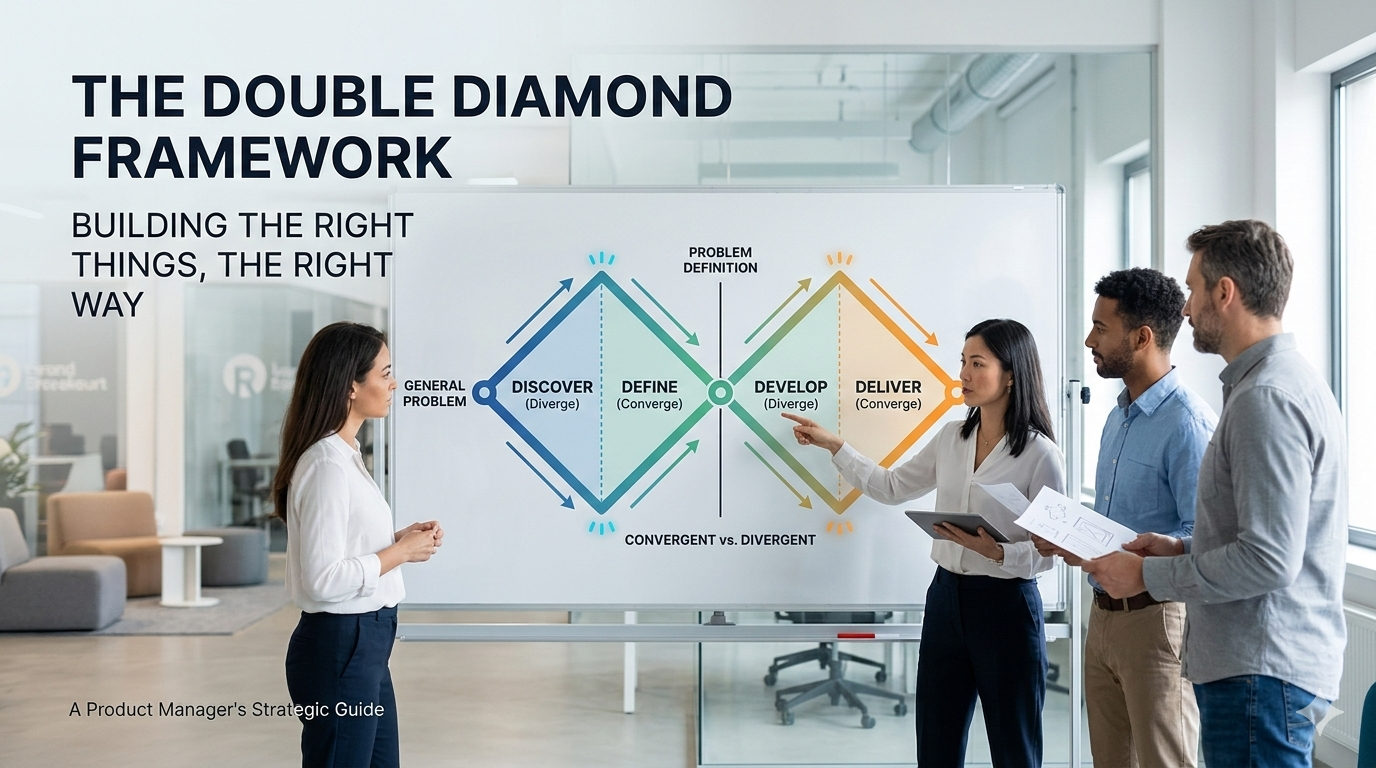
Developed by the British Design Council in 2005, the Double Diamond is divided into four stages: Discover, Define, Develop, and Deliver.
The “shape” of the diamond is the most important part. It represents two cycles of Divergent and Convergent thinking.
- Divergent thinking (Opening up): You explore as many possibilities as possible. No idea is too “out there,” and no data point is too small. You are expanding your horizon.
- Convergent thinking (Narrowing down): You take all those messy ideas and data points and start making hard choices. You filter, prioritize, and focus on the single most impactful path forward.
Diamond 1: Solving the Right Problem
The first diamond is all about Discovery and Definition. In many ways, this is the most critical phase for a PM. If you get this wrong, the rest of the work is a waste of company resources.
1. Discover (Diverge)
You start with a “General Problem” or a hunch. For example: “Our user retention is dropping.” Instead of guessing why, you go wide. You look at Mixpanel or Amplitude data, you run heatmaps, and—most importantly—you talk to users. You aren’t looking for solutions yet; you are looking for pain points, frustrations, and behaviors.
2. Define (Converge)
Now, you have a mountain of messy feedback. The “Define” phase is where you play detective. You look for patterns. You might find ten reasons why retention is dropping, but the data shows that 70% of users quit because the onboarding process takes more than five minutes.
You end this phase with a Problem Statement.
“Users are dropping off because the initial setup requires too much manual data entry, leading to ‘onboarding fatigue’ before they see the product’s value.”
Diamond 2: Solving the Problem Right
Now that you know exactly what the monster looks like, it’s time to kill it. This is the Design and Implementation phase.
3. Develop (Diverge)
The PM brings the engineers and designers into the room. You brainstorm.
- Can we use an API to auto-fill the data?
- Can we skip this step and let them do it later?
- Can we use a “wizard” interface?
You create wireframes, low-fidelity prototypes, and “crazy 8s” sketches. You are exploring the “Solution Space.”
4. Deliver (Converge)
Finally, you narrow it down. You pick the solution that is technically feasible, viable for the business, and most usable for the customer. You build an MVP (Minimum Viable Product), test it with a small group of users, gather the feedback, and then—finally—ship the polished version.
Putting it Into Practice: Two Real-World Examples
Example 1: The “Abandoned Cart” Crisis (E-commerce)
- Discover: A PM at a fashion retailer sees that 65% of users add items to their cart but never buy. They run surveys and find users complain about “hidden costs,” “slow shipping,” and “too many forms.”
- Define: After looking at the data, the PM realizes the “Shipping Calculator” only appears at the very last step. The Problem: Users feel “tricked” by the final price including shipping.
- Develop: The team ideates: Free shipping over $50? A real-time shipping estimator on the product page? A flat-rate shipping banner?
- Deliver: They A/B test a “Shipping Estimator” on the product page. Conversions jump by 12%. They roll it out to all users.
Example 2: The “Ghost Town” Feature (SaaS)
- Discover: A PM for a project management tool notices that the “Team Chat” feature is barely being used. They interview power users and find they still use Slack or WhatsApp for quick chats.
- Define: The interviews reveal the built-in chat is too “formal”—it feels like sending an email, and there’s no notification system. The Problem: The chat lacks the “instant” feel required for quick team syncs.
- Develop: Ideas include: Adding “typing” indicators, push notifications, emoji reactions, or even a Slack integration.
- Deliver: They decide to implement push notifications and a “Compact View.” Engagement with the feature triples within the first month.
The PM’s Takeaway
The Double Diamond is a reminder that thinking is just as important as doing. As a PM, your job is to be the guardian of the diamonds. When a stakeholder tries to force a solution on you in the middle of the “Discover” phase, you use this framework to pull them back. By staying disciplined and following the process, you ensure that every feature you ship actually moves the needle for your users and your business.